📏
← BackThales' Theorem
📘 Definition
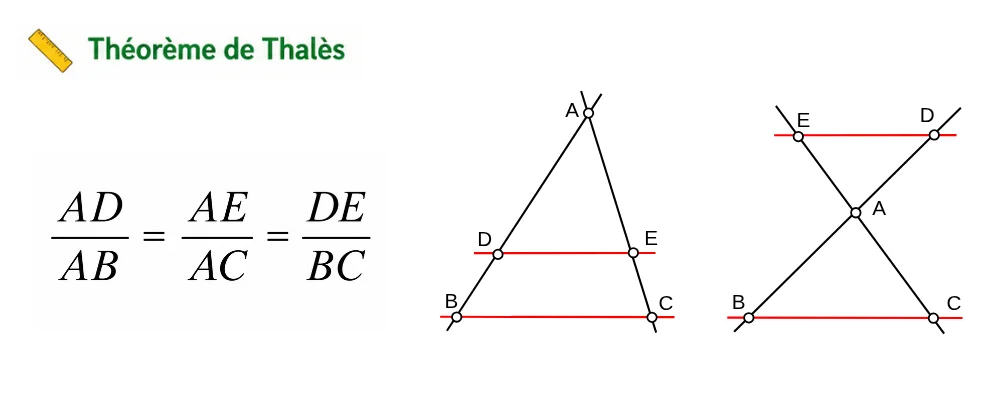
Thales' Theorem
Let ABC be a triangle and D and E two points, with D on line (AB) and E on line (AC), such that line (DE) is parallel to line (BC).
AD / AB = AE / AC = DE / BC
Converse of Thales' Theorem
In triangle ABC, if D belongs to [AB] and E belongs to [AC], and if AD/AB and AE/AC are equal, then lines (DE) and (BC) are parallel.
🧠 Formula
AD / AB = AE / AC = DE / BC
✏ Example
2 / 4 = 2 / 4 = 3 / 6